

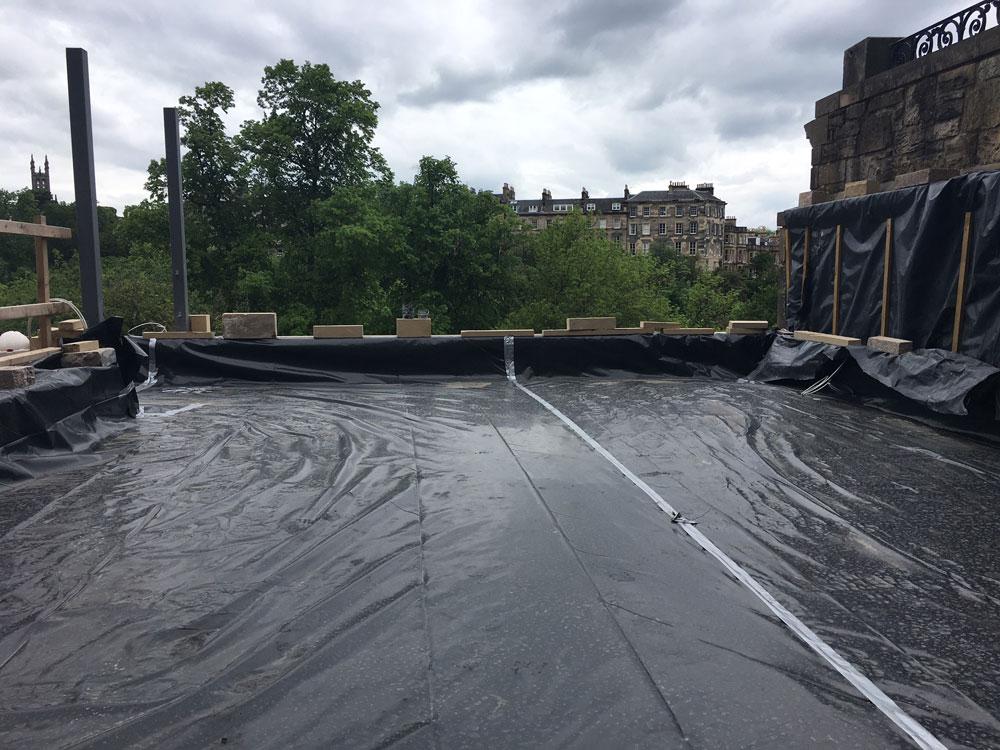
Andrew Devitt of the Property Care Association explains why competency, design‑led strategies and robust risk assessment are essential to preventing below‑ground waterproofing failures and protecting long‑term building performance
Basement accommodation continues to grow, providing much needed living space especially in towns and cities where there is limited open space to extend and where land costs are high. In some boroughs of London, domestic accommodation below ground level amounts to over 4.5 per cent of the housing stock which is significant. Basement living provides a much-needed requirement for UK housing in densely populated areas.
The structural waterproofing requirement of basements below the ground remains one of the highest risk elements of both new and retrofit construction. Whether in residential developments, commercial premises, public buildings or critical infrastructure, protecting occupied space from groundwater, surface water and ground gases is fundamental to the long-term performance and resilience of a structure below the ground.
When waterproofing systems in below ground construction, the consequences can be severe. Water ingress can result in substantial financial losses for clients, insurers and businesses alike, while investigation, remediation and reinstatement can take many months or even years. Importantly, failures are not always the result of poor workmanship. In many cases, the root cause lies within the design process itself, including inadequate consideration of site conditions, unsuitable waterproofing strategies or insufficient risk assessment.
Whilst no comprehensive national dataset exists, water ingress remains one of the most significant causes of building defects and insurance claims in the UK. The wider economic impact extends beyond repair costs to include business interruption, temporary accommodation, professional fees, reputational damage and loss of productivity.
It is therefore unsurprising that warranty providers such as NHBC, Premier Guarantee and LABC Warranty increasingly place emphasis on: compliance with BS 8102:2022 Protection of below ground structures against water ingress — Code of practice; assessment of geology, hydrogeology with intended use; appointment of a suitably qualified Waterproofing Designer; documented waterproofing strategies; and quality assurance during installation.
This reflects a growing recognition that waterproofing failures should not simply be viewed as construction defects. More often, they are systems failures involving multiple stakeholders including clients, architects, engineers, contractors, waterproofing specialists, warranty providers and insurers.
From waterproofing products to waterproofing strategies
Over the last two decades, the waterproofing sector has undergone a significant transformation. Historically, project teams often focused on products and guarantees. Today, the emphasis is increasingly on competency, risk assessment and design-led solutions.
The publication and development of BS 8102 has been instrumental in this change. The current edition, BS 8102:2022, promotes a risk-based approach to the protection of below ground structures and requires consideration of factors such as geology, groundwater conditions, topography, construction methodology and the consequences of failure.This shift acknowledges a fundamental reality, successful waterproofing cannot be achieved through product selection alone. Effective protection requires a coordinated approach involving competent design, appropriate specification, quality installation and ongoing management of risk.
For government, local authorities and public-sector asset owners, this message is particularly important. Failures affecting basements, archives, plant rooms, underground infrastructure and occupied spaces can disrupt services, impact building users and generate significant financial liabilities.
Learning from the past
Long before the Building Safety Act placed competency at the heart of construction quality, specialist sectors were already recognising the need for independently verified standards.
An example was a Basement Insurance Scheme developed by an Affinity warranty provider and a specialist underpinning trade association. This specialist insurance cover introduced during the growth of the UK basement construction market, sought to address the increasing risks associated with deep excavation, structural waterproofing and below ground development.
Although insurance formed part of the solution, the true significance of the scheme was its focus on risk reduction rather than compensation after failure. The scheme promoted technical competence, quality assurance and professional accountability, demonstrating that defects could be reduced through better planning, oversight and specialist expertise. The principles represented an important shift in industry thinking. Instead of accepting defects as an inevitable consequence of construction, the scheme promoted the idea that failures could be significantly reduced through better planning, improved oversight and greater technical competence.
Whilst affinity insurance schemes are no longer available, their legacy remains highly relevant. They demonstrated how trade associations, training teams, insurers and specialist contractors could work collaboratively to improve standards and reduce claims through proactive risk management.
The Property Care Association’s (PCA) role in raising standards
For more than twenty years, the PCA has played a central role in advancing standards within the structural waterproofing sector. The Association has consistently promoted the principle that risks should be identified and mitigated before construction commences. Whether dealing with foundations, retaining walls, underground car parks or deep habitable basements, the PCA has championed a design-led approach that prioritises long-term performance, resistance and resilience.
This philosophy aligns directly with BS 8102:2022 and the recommendations for the early assessment of groundwater, geology, hydrogeology, topography and environmental conditions.
A significant part of this work has involved developing training, qualifications and competency frameworks for professionals operating within the sector. The Association recognised early that reducing failures required more than product knowledge, demanding an understanding of design principles, construction methodology and risk management. As a result, structural waterproofing has evolved into a recognised professional discipline.
Competency in the era of building safety
The Building Safety Act has accelerated the construction industry’s focus on competency. Central to this agenda is the principle of Skills, Knowledge, Experience and Behaviours (SKEB), ensuring that those responsible for critical elements of design and construction are able to demonstrate competenceappropriate to their role.
The PCA, working with CITB and industry stakeholders, has recognised that competency requirements within structural waterproofing must continue to evolve.
Historically, the Certificated Surveyor in Structural Waterproofing (CSSW) qualification became recognised as the benchmark standard for waterproofing designers. Today, however, competency extends beyond design knowledge alone.
Modern waterproofing projects require an understanding of risk assessment, construction sequencing, installation practices, inspection procedures and long-term performance. A successful design must be both buildable and capable of performing throughout the design life of the structure.
This broader approach reflects Section 4.2 of BS 8102:2022, which identifies the importance of the Design Team. The Standard recognises that successful outcomes depend upon collaboration between designers, engineers, contractors, specialist suppliers and the Waterproofing Design Specialist.
Raising the bar further
For many years, the PCA has maintained a Waterproofing Design Specialist Register, providing clients and project teams with access to recognised expertise. More recently, competency standards for entry onto the register have been strengthened significantly. Drawing on SKEB principles, candidates are now assessed against a benchmarked framework that extends beyond design capability and includes understanding of: construction techniques and sequencing; waterproofing materials and system selection; installation methodologies; site quality assurance; inspection and verification processes; documentation and evidence gathering; and certification and underwriting considerations.
The competency framework recognises that waterproofing failures rarely result from a single design or installation error. By requiring candidates to demonstrate both technical design expertise and practical construction awareness, the PCA is helping bridge the gap between design intent and construction delivery.
By requiring candidates to demonstrate both technical design expertise and practical construction awareness, the PCA is helping bridge this gap and improve the resilience of below the ground structures. The competency model also aligns with insurer and warranty provider expectations. The industry’s focus is increasingly on ensuring that waterproofing strategies are practical, buildable, inspectable and capable of supporting latent defects insurance protection for completed structures. The PCA’s competency framework and specialist register provide confidence that registered practitioners possess the skills, knowledge and experience necessary to develop robust waterproofing solutions. The benchmarking process therefore assesses a wide range of competencies including risk analysis, design specification, materials knowledge, construction sequencing, site oversight, certification and underwriting awareness.
A competency-led future
The structural waterproofing sector has travelled a considerable distance over the last twenty years. The focus has evolved from products and guarantees towards competency, collaboration and risk management.
For insurers, warranty providers, clients and asset owners, this evolution provides greater confidence that projects are being designed and delivered by suitably qualified professionals, resulting in reduced risk and improved long-term performance.
Most importantly, it reinforces a fundamental principle: successful structural waterproofing begins long before installation starts on site. It begins with competent people making informed decisions, understanding risk and developing effective strategies for protecting below-ground structures.
The PCA has been promoting this philosophy for many years and continues to lead the sector in developing the competency standards needed to meet the challenges of modern construction. In doing so, it is helping to ensure that that all structures built below ground today remain dry, durable and insurable tomorrow.